


Packaging strategy

Sustainable packaging has long been a core concern for Allgäu Organic Dairies. In 2018, ÖMA once again placed a strong focus on making packaging more environmentally friendly. “The fact that ÖMA not only prioritises taste but always keeps the overall environmental impact of a product in mind is demonstrated by a number of advances in the field of sustainable cheese packaging
.”“We know that we are still in the early stages of developing sustainable packaging solutions,” says Head of Administration Ulrich Kurz, who has been taking a more active role in this area. “There is as yet no magic formula for environmentally friendly packaging that can be used for cheese. We are working with various manufacturers and research partners on bespoke solutions for our cheeses and hope to be able to take further steps, bit by bit, towards using less packaging or more sustainable packaging.”
.”“We know that we are still in the early stages of developing sustainable packaging solutions,” says Head of Administration Ulrich Kurz, who has been taking a more active role in this area. “There is as yet no magic formula for environmentally friendly packaging that can be used for cheese. We are working with various manufacturers and research partners on bespoke solutions for our cheeses and hope to be able to take further steps, bit by bit, towards using less packaging or more sustainable packaging.”
All developments in sustainable packaging solutions at ÖMA proceed in small steps, each requiring patience, yet together they deliver a more effective outcome in terms of waste reduction, recyclability, and other environmental goals.
We are all called upon to address the issue of packaging. Here, we should defy the packaging craze and question, for every product, how much packaging is justified. From our experience, we know that as a small to medium-sized enterprise, we are a slightly more interesting customer for the packaging industry. After all, a single company can achieve little on its own in this area. However, if the specialist organic food retail sector works together to find new solutions, we have a chance to take a step towards less or more sustainable packaging.
The Green Dot

With this logo, we wish to demonstrate that we are a member of the Green Dot scheme and thereby fulfil our obligations to participate in the system in accordance with the Packaging Act.
Our Green Dot registration number is: 5521296
. Green Dot confirmation of participation 2026 (PDF)
Our Green Dot registration number is: 5521296
. Green Dot confirmation of participation 2026 (PDF)
Packaging recycling is a key factor in reducing greenhouse gas emissions and thus makes a decisive contribution to climate protection. “Packaging should not become waste” – that is the principle behind the Dual System. Participation in this recycling scheme is mandatory. Nevertheless, it is important to consider the – positive – effects this has had.
ÖMA is also registered in the LUCID packaging register.
Our LUCID registration number is: DE4088527711380
ÖMA is also registered in the LUCID packaging register.
Our LUCID registration number is: DE4088527711380
The strategy for new packaging
ÖMA is pursuing various strategies in its search for sustainable packaging solutions, as the switch to new cheese packaging always depends on countless factors. These factors include, amongst others, the machine compatibility of the new materials – that is, the suitability of existing machinery for processing the new material. Or, for example, the protective function – this must be at least equivalent when using alternative materials. When considering a potential changeover, the following approaches, amongst others, are carefully evaluated:

Reduction
: Eliminating packaging and packaging components wherever possible
. Reduction in material usage, for example by changing container types or using thinner films.
: Eliminating packaging and packaging components wherever possible
. Reduction in material usage, for example by changing container types or using thinner films.

We are also committed to sustainability, replacing
conventional materials with certified-organic and compostable alternatives whenever possible.
conventional materials with certified-organic and compostable alternatives whenever possible.

Our packaging is designed for recycling
from the very start, using sortable, separable materials or single-material
solutions.
from the very start, using sortable, separable materials or single-material
solutions.

Education, tips & tricks
One of the most effective strategies for reducing waste is educating consumers. Here are a few examples where raising awareness would help reduce packaging waste:
1) Protection against spoilage: If packaging is omitted, the product may spoil more quickly as it is exposed to external factors. > Packaging is definitely preferable
to food waste. 2) How can cheese be packed correctly at home or bought with minimal packaging (e.g. by using your own storage containers when buying from the cheese counter)?
3) Balancing packaging against CO₂ reduction: Packaging such as glass containers would generate higher emissions during transport than lightweight plastic film packaging.
Did you know?
While many of our sustainable, bio-based packaging materials (such as films made from maize starch) are derived from renewable resources and are therefore more resource-efficient than petroleum-based films, the existing recycling infrastructure in Germany is not yet able to collect and recycle them separately from other materials. As a result, they are currently sent to thermal recovery—in other words, incinerated. The recycling sector still has some catching up to do in this area,
although the process does generate energy for other operations within the recycling company.
although the process does generate energy for other operations within the recycling company.
Packaging successes

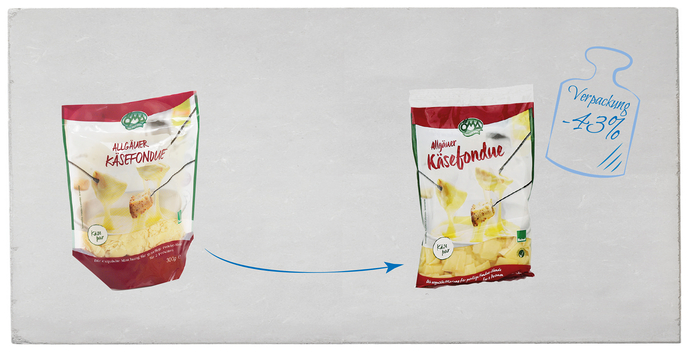
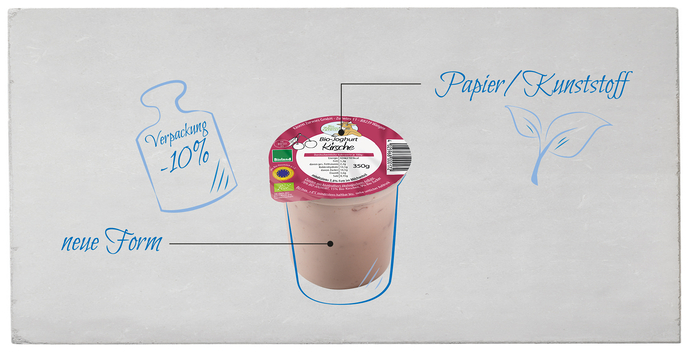
Did you know?
Yoghurt lids!
Please dispose of the lid separately from the yoghurt pot. Packaging components made of different materials that are joined together cause major problems during recycling. Packaging that cannot be separated into its individual components cannot be fully recycled.
Only materials from packaging collected via the ‘Yellow Bag’ or ‘Yellow Bin’ collection points, or via glass and paper recycling bins, remain in the recycling loop. Anything that ends up in general waste is predominantly incinerated and is therefore lost to the recycling loop forever.
Only materials from packaging collected via the ‘Yellow Bag’ or ‘Yellow Bin’ collection points, or via glass and paper recycling bins, remain in the recycling loop. Anything that ends up in general waste is predominantly incinerated and is therefore lost to the recycling loop forever.
FAQ
Why buy cheese at the counter?
At the service counter, cheese is sold by the slice, freshly cut from the wheel in the exact quantity you need. You can choose to have it wrapped in eco-friendly cheese paper or placed in your own storage container. This is freshness at its best.
Why do we use plastic pourers for ÖMA coffee milk and ÖMA coffee cream?
At present, we are not yet technically able to screw the pourers onto the bottles only partially. Furthermore, retailers do not want us to supply bottles without pourers and have separate containers with pourers set up.
Nevertheless, we’re keeping at it!
Nevertheless, we’re keeping at it!
Why don’t we package ÖMA California cream cheese and ÖMA Cottage Cheese in jars?
When considering the environmental impact of glass compared to other types of packaging, glass does not fare well. Glass can only be produced at extremely high temperatures of 1,600°C and remelted during recycling; this consumes a great deal of energy and consequently generates a significant amount of CO₂. A key factor is transport weight – CO₂ emissions during transport would be significantly higher here, as glass is much heavier than plastic (particularly in terms of grammage). Transport costs would rise considerably. These increased transport costs would in turn be reflected in the price of ÖMA California or ÖMA Cottage Cheese.
Fuel consumption during transport accounts for a very significant part of a product’s life cycle assessment, and in this respect, lightness is key. Although plastic, like fuel, is made from fossil-based materials, plastic made from monomaterials can at least be recycled, unlike fuel.
When returnable glass jars are transported back to the manufacturers, CO₂ emissions are generated once again. Before returnable glass jars can be refilled, they must be cleaned. This requires strong cleaning agents and a lot of water. This, too, has a negative impact on the life cycle assessment.
How is the new sliced cheese packaging separated?

Properly separating the packaging is essential so that it can be fully recycled, and we strive to make this as simple as possible for consumers.
Instructions on how to separate and recycle the packaging correctly can also be found on the back of the slice pack.
Further information is also available on the website of our packager, Albert Herz GmbH.
Instructions on how to separate and recycle the packaging correctly can also be found on the back of the slice pack.
Further information is also available on the website of our packager, Albert Herz GmbH.

The paper on the tear-off tab (bottom left) has a special coating, making it very easy to grip the lower film layer here.
Peel the film upwards along the long side to separate it from the cardboard tray. The top film and the film on the tray can then be placed in the yellow bag or yellow bin.
The cardboard tray is made from 100% paper. It can be torn lengthwise but not crosswise, as the fibres run lengthwise. Because the tray contains no plastic, it can be placed in the recycling bin for paper without any issues.
Further information and details of the benefits of our cheese slices in paper packaging can be found here.
Why do we mainly use petroleum-based films?
Alternatives (e.g. films based on maize starch) are not currently offered by film manufacturers for our purposes. Cheese is a very sensitive product and the choice of film is made according to strict quality standards. These films contain additional barrier layers that facilitate gas exchange within the packaging—a process essential for the ripening of all types of cheese. We have carried out storage trials with cellulose film, but this proved unsuitable.
Optimising packaging is a major priority for us. We remain in close dialogue with manufacturers and research institutes, exploring every option.
Balancing multiple environmental factors is essential, so our current focus is on reducing material use and improving recyclability.
Optimising packaging is a major priority for us. We remain in close dialogue with manufacturers and research institutes, exploring every option.
Balancing multiple environmental factors is essential, so our current focus is on reducing material use and improving recyclability.
Is the packaging for ÖMA California, cream cheese and ÖMA Cottage Cheese made from 100% aluminium?
No, the side of the packaging facing the product is coated with a thin layer of polyethylene. This seals the aluminium tray to the pot and ensures that the product is tightly sealed.
As a result, the product does NOT come into contact with the aluminium tray.
As a result, the product does NOT come into contact with the aluminium tray.
Which ÖMA cheeses are sold unpackaged?
Cheeses matured under bark are dispatched from our premises as whole wheels ‘unpackaged’. For hygiene reasons and to ensure optimum product protection, all other products cannot be sold unpackaged.